

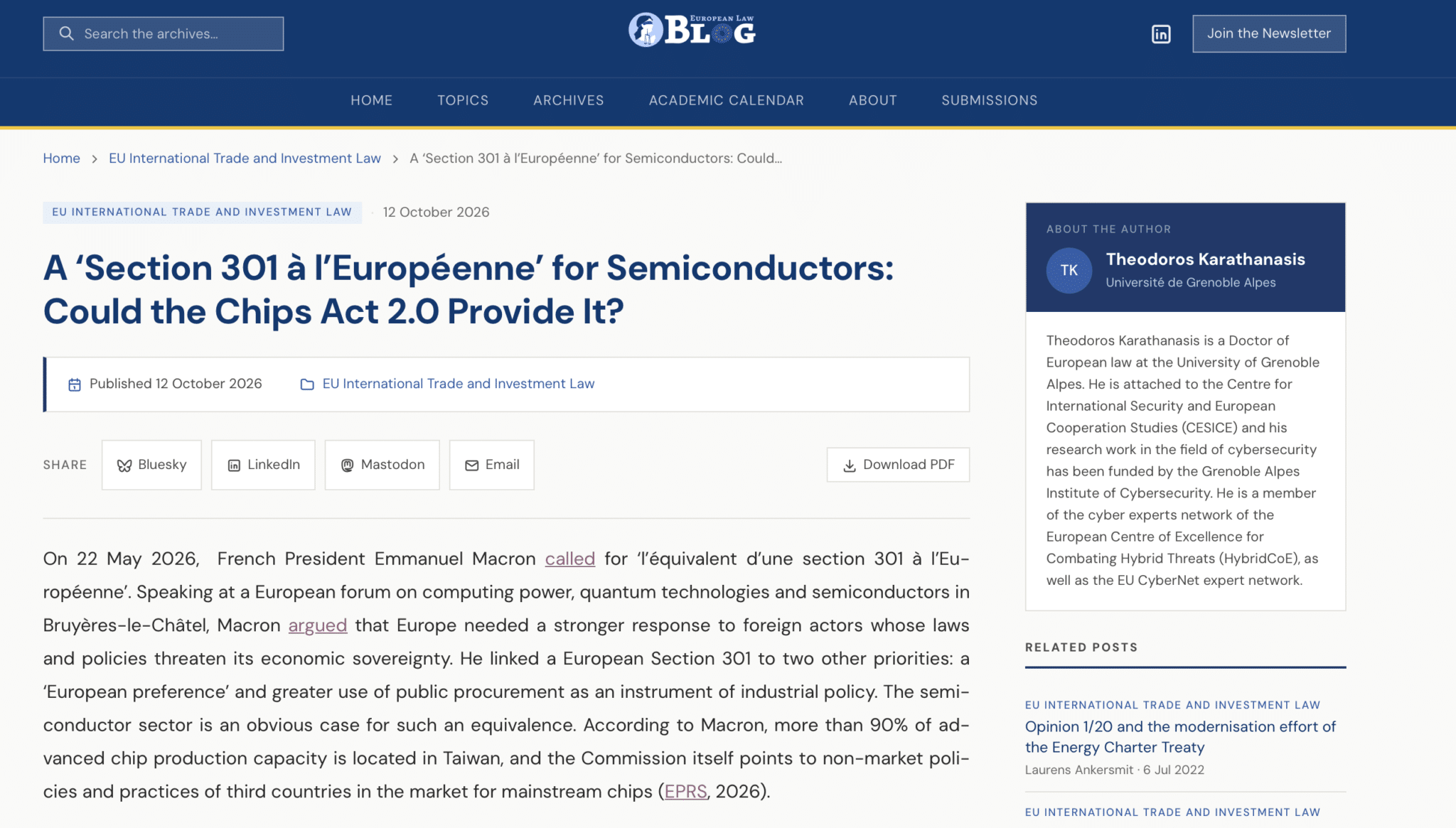
The Chair AI Regulation is pleased to share information about a new paper titled ‘A ‘Section 301 à l’Européenne’ for Semiconductors: Could the Chips Act 2.0 Provide It?’ by its research fellow, Dr. Theodoros Karathanasis, and published at the European Law Blog.
Abstract:
Prompted by President Macron’s call in May 2026 for a European equivalent of US Section 301, the post asks whether EU law already contains such a tool for semiconductors. The author draws four benchmarks from Section 301: an investigation the EU executive can open on its own initiative, a decision taken by that executive, a remedy that applies without the target country’s consent or a prior WTO ruling, and a trigger and remedy aimed specifically at chip supply risks.
Measured against these benchmarks, the existing instruments fall short. The International Procurement Instrument meets the procedural criteria but fails the fourth, because it responds to foreign procurement barriers against EU firms rather than to risks to the EU’s own supply. The Anti-Coercion Instrument could cover pressure on semiconductor policy, but because only the Council can find coercion, it works as a slow, case-by-case deterrent rather than a standing sectoral tool. The Chips Act 2.0 proposal comes closest through its “security of supply declaration” in public procurement (Articles 30–32). However, it neutralises that declaration by making it optional and requiring it to remain non-decisive in contract awards.
The author proposes two amendments: make the declaration a mandatory award criterion, and replace the “non-decisive” rule with a cap of 15% of the total score, applied only to bidders whose chip supply chain includes non-domestic firms. The author argues that a capped criterion, unlike outright exclusion, would comply with the Court of Justice’s case law on proportionality (Michaniki) and on award criteria (Concordia Bus). It would also remain within the internal-market legal basis of Article 114 TFEU rather than the common commercial policy. One acknowledged limit is that firms from WTO Government Procurement Agreement parties count as “domestic,” so the tool would not address US extraterritorial measures. Those would remain a matter for the Anti-Coercion Instrument.
The full article is available here.
These statements are attributable only to the author, and their publication here does not necessarily reflect the view of the other members of the AI-Regulation Chair or any partner organizations.
This work has been partially supported by MIAI @ Grenoble Alpes, (ANR-19-P3IA-0003) and by the Interdisciplinary Project on Privacy (IPoP) commissioned by the Cybersecurity PEPR (ANR 22-PECY-0002 IPOP).